
Generation Is No Longer the Bottleneck. Validation Is.
By Olivier Schwartz | November 2026 | Insights from PHUSE EU Connect 2026 (Glasgow)
If there was one unmistakable consensus across three days in Glasgow at PHUSE EU Connect 2026, it is that artificial intelligence has moved past the experimental phase in clinical programming. According to longtime attendees who have followed the conference over the past four to eight years, AI’s presence on the agenda has never been stronger.
Yet the conversation among biostatisticians, statistical programmers, and regulatory experts has matured significantly. The industry is no longer asking whether AI can generate code. It is asking a far more critical question: how do we trust, audit, and govern what it produces?
1. The Shift from Code Generation to Evidence Architecture
A recurring theme throughout the conference was that code generation is no longer the constraint; validation is. A point underscored by Henning Kuich (Verisian) in his Session : Who Checks the AI? Making AI-Generated Analyses Auditable. Working from the premise that “code is the source of truth,” Kuich noted that while AI accelerates code output, validation resists automation. Because Statistical Analysis Plans (SAPs) and dataset specifications begin drifting from code the moment implementation starts, teams must make specifications “AI-ready” before automating anything and place domain experts at clearly defined quality gates.
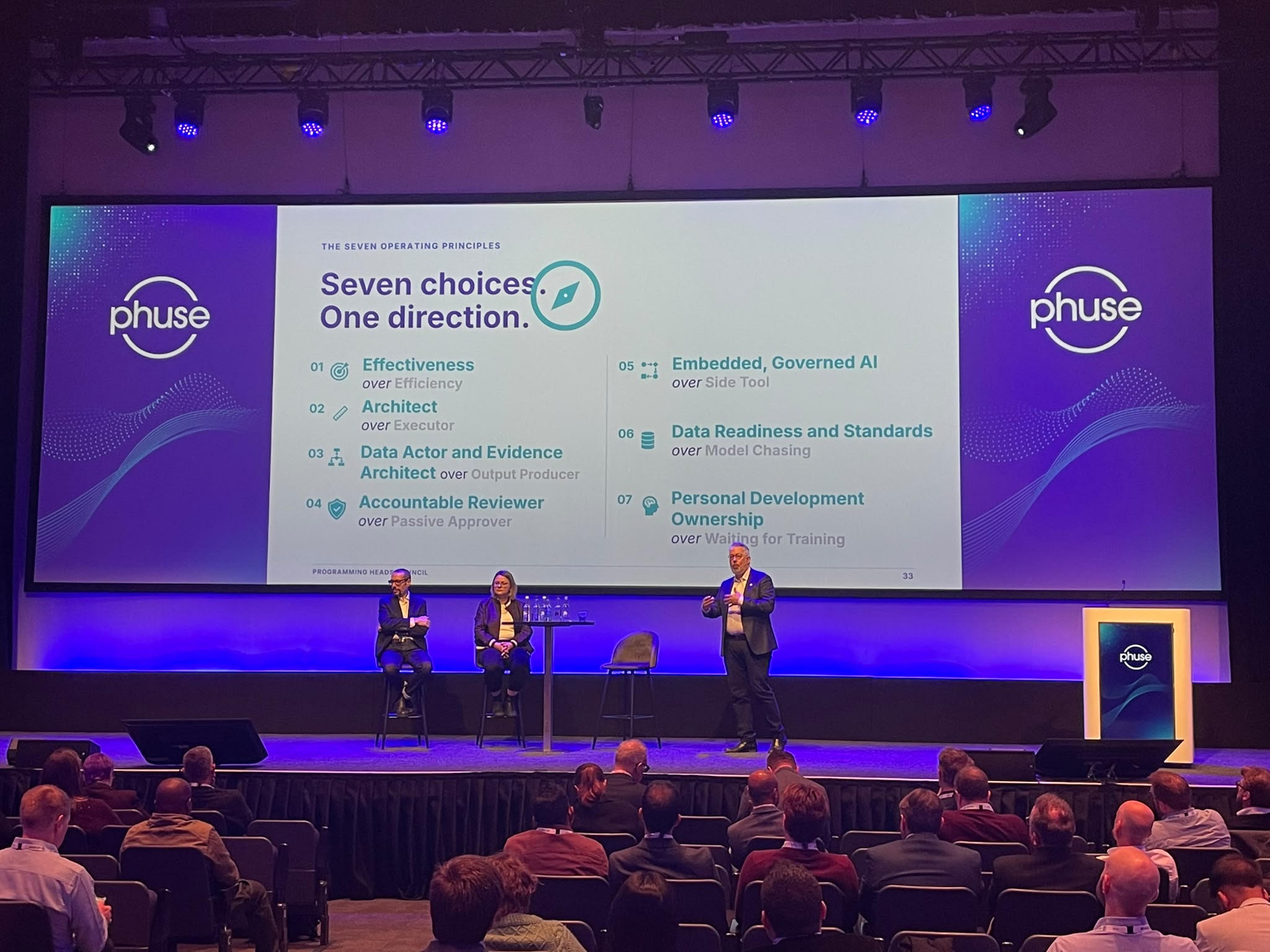
This shift was quantified during the Day 2 Keynote, Beyond Code: Evidence Generation in an AI Era, delivered by representatives of the Pharma Programming Heads Council : Sascha (Bayer), Julia (Boehringer Ingelheim), and Alberto (UCB). Live audience polling revealed that while 95% of attendees use AI for knowledge retrieval and 25% use it to generate SDTM or ADaM code, only 10% currently use it for quality or consistency checks. As the speakers emphasized, trustworthy clinical evidence requires “provenance by design”. a defensible audit trail capturing inputs, execution context, outputs, and human review built directly into the workflow rather than reconstructed before an inspection.
- Security and discipline first: In his Session : A Skeptic’s Guide to Using AI for Programming, Frank Menius (Atorus Research) warned against entering proprietary code, credentials, or patient data into non-secure AI tools (“once on the internet, always on the internet”), advocating instead for strict team style guides, rich prompting context, and rigorous validation.
- Data standards remain the foundation: In her Session : Automating the Factory Floor, Tamara Senior (Roche) demonstrated how an R-based automation framework (using custom packages such as curateR and complianceR) reduced SDTM curation time per study by over 95%. Cutting turnaround from one week to one or two hours, with automated pipeline execution taking just 10 minutes. Standardized datasets, she noted, are what allow teams to strategically evaluate where LLMs can safely add value.
- Continuous GxP compliance: In her Session : AI – The New “x” in GxP, Kamila Duniec cautioned against the illusion of early “norming,” stressing that record integrity, transparency, and human accountability must remain front and center as AI tools continuously evolve.
2. R and the Open-Source Ecosystem Take Center Stage
In the long-standing debate over statistical programming languages in pharma, the momentum in Glasgow was clear: R is stronger than ever.
Driven by the rapid maturity of the pharmaverse ecosystem, open-source packages are increasingly becoming the backbone of clinical reporting and interactive medical data review:
- Interactive review and visualization: Fabian Röthleithner and Korbinian Matthias (Boehringer Ingelheim) (Session : Validating R Shiny Applications – A DaVinCI Case Study) showed how cross-functional collaboration between software engineers, trial programmers, and safety physicians delivers real-time clinical insights while staying adaptable to emerging agentic workflows. Similarly, Natalja Nassonova and Magdalena Krochmal (Roche) (Session : R-Evolutionizing Medical Data Review in Neuroscience Through {teal}) demonstrated how open-source {teal} modules modernize Medical Data Review across safety, clinical, and statistical teams.
- Scaling submissions and reporting: In Session : Reimagining eSubmission Support at Roche, Helene Royo (Roche) noted that 20 out of 23 surveyed pharmaceutical companies expect their R usage to grow, outlining Roche’s strategic shift toward R-based regulatory filings alongside curated AI knowledge assistants (eSME, eSub Handbook, and eSub Engine). Chi Zhang (Roche) (Session : Moving Forw-ARD) highlighted how NEST 2.0 (Citril and Crane) paired with {gtsummary} lowers the barrier to clinical reporting.
- Open-source validation and reusable frameworks: Rupesh Katta and Andrea Gardani (Alira Health) showcased wrapping the open-source CDISC CORE conformance engine in R Shiny for interactive validation and traceable run histories. Meanwhile, Matthew Phelps and Aksel Thomsen (Novo Nordisk) presented the open-source {mighty} framework to treat ADaM programs as build artifacts, and Paul Shannon (Katalyse Data) demonstrated how version-controlled YAML configurations in Git automate the deployment, validation, and audit trails of a Validated Statistical Computing Environment (VSCE).
While SAS is not the reference solution as it was before, Python remains concentrated in exploratory data science. Though Mahdi About (Session : One Import, Every Layer) noted that 70% of applicants in an early-phase recruitment campaign listed Python as their first language, introducing fleet as a unified toolbox bridging the CDISC library to clinical tables in Python.
3. Data-Driven Submissions Beyond the PDF
Regulatory bodies and sponsors are rethinking how clinical evidence is structured, connected, and reviewed.
- The EU transition beyond static PDFs: In her Session : Shaping the Future of Clinical Study Data Submission in the EU, Marie Örre (EMA) shared updates on the EMA’s clinical study data pilot (running through Q1 2027, with a transition phase later in 2027). Early access to structured data, metadata, executable code, and interactive outputs has already improved assessor understanding and streamlined inspections.
- Connected, reusable evidence layers: Chad Logan and Barbara Doll (Boehringer Ingelheim) (Session : Hierarchical Data Models for Analysis Results Data) demonstrated how combining Analysis Results Standards (ARS) with Analysis Results Data (ARD) — using pharmaverse packages like cards and cardx — turns analyses into navigable objects from which multiple outputs can be derived. John McDade (Phastar) (Session : TrialHub) showed how ontologies and GraphRAG connect fragmented trial documents (protocols, SAPs, ADaM, and SDTM) into cross-study knowledge graphs. Meanwhile, Tom Smeets (OCS) and Filip Beeldens (Argenx) illustrated how an SDTM-like framework (BM-SDTM) preserves lineage and future reusability for exploratory biomarker data.
4. Redefining the Role of the Statistical Programmer
Perhaps the most candid discussions in Glasgow centered on the human element, and a shared concern across the industry: what happens to foundational programming expertise if teams rely too heavily on AI?
- From code apprentices to evidence architects: During the Day 2 Keynote, Alberto (UCB) and his fellow panelists argued that the industry must move from “code apprenticeship to evidence apprenticeship.” Accountability cannot be delegated to an algorithm any more than it can be delegated to a CRO. Junior programmers still need hands-on exposure to real data, debugging, and simulations so they build the critical thinking and analytical judgment required to spot plausible-sounding AI errors.
- AI-enabled workflows and “skills”: In their Session : The Evolving Role of the Analytic Software Developer, Alanah Jonas and Andy Nicholls (GSK), noting that GSK moved 100% of its code to open source in 2026, highlighted how providing structured, repeatable “skills” (recipes) to AI yields consistent engineering outcomes while shifting developers toward higher-level orchestration. Similarly, in his Session, Rafik Ghazaryan (BioBrain Pro) reminded attendees reviewing unstructured free-text patient diaries that “automation supports the review; it never replaces it.”
- Closing the human ownership gap: In their Session : Leadership in AI, Sycamore Informatics reported that 68% of enterprise AI friction stems from unclear human ownership rather than technical limits. Complementary insights from Anders Högberg (Capish) (Session : Data Democratization) and Julie Tobback and Inge Leysen (SGS) (Session : Breaking Biometrics Silos) reinforced that successful modernization requires clear governance, cross-functional training, and early multi-disciplinary alignment under ICH E6(R3) and M11.
What This Means for Clinical Data Teams
PHUSE EU Connect 2026 made one thing clear: competitive advantage in clinical biometrics will not come from adopting the flashiest AI tool. It will come from disciplined data engineering, rigorous validation frameworks, open-source fluency, and teams empowered to exercise sound scientific judgment.
At Lucid Analytics, this aligns directly with how we partner with life sciences organizations across Switzerland and Europe, helping teams modernize their statistical computing environments, adopt open-source R and pharmaverse workflows, and build traceable, inspection-ready data pipelines.
Attended PHUSE EU Connect 2026 or looking to modernize your clinical programming and validation workflows? Reach out to our team and if you would like access to any of the conference slide decks referenced above, feel free to get in touch.