

Rust began as a systems programming language with a sharp focus on safety and performance. Those same qualities make it a strong fit for modern data pipelines, large-scale genomics, and clinical analytics, domains where reliability, efficiency, and reproducibility matter.
The result is a young but fast-moving ecosystem in which Rust increasingly operates underneath Python and R, handling performance-critical components while higher-level languages remain the primary interface for analysis and modeling.
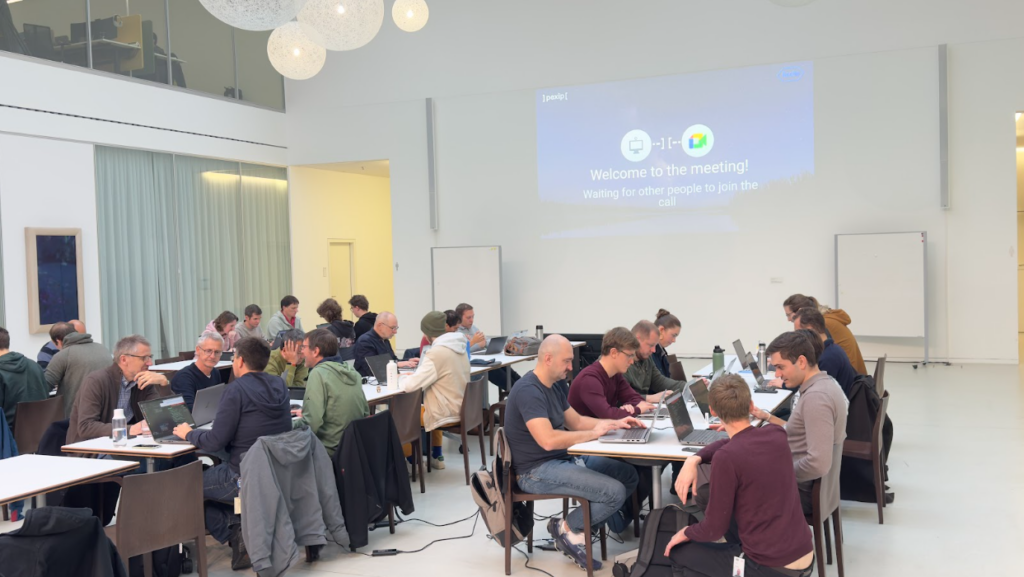
In this context, Francesco Cozzolino at Lucid Analytics designed and delivered a dedicated Rust training program for a large pharmaceutical organization, aimed at strengthening internal capabilities in high-performance and production-grade scientific computing. The training follows Lucid’s long-standing emphasis on gamification as a learning strategy, and the associated materials are publicly available (https://frankcozzolino.github.io/echoesoftheashes).

Why Rust fits scientific computing
Rust is increasingly showing up in scientific and quantitative systems for three clear reasons:
Memory safety without a garbage collector: Rust removes entire classes of memory bugs that plague C/C++ codebases in HPC and bioinformatics, without paying the cost of a runtime garbage collector (Bioinformatics, 2016).
Predictable high performance: with no runtime GC pauses, and explicit control over allocation and data layout, Rust delivers consistent low-latency performance. This matters for large-scale numerical workloads, streaming pipelines and real-time analytics (rust-ml.github.io).
Great FFI (foreign-function interface): Rust interacts cleanly with C, Python, and R, through mature FFI tooling. That makes it easy to embed Rush components into existing pipelines rather than rewrite them end-to-end (JOSS, 2024 and scientificcomputing.rs).
In practice, Rust is not replacing R or Python. It is quietly becoming the new “C++ underneath”, quietly powering data science and life science stacks.
Data science in Rust: Polars and ML toolkits
DataFrames and data wrangling
The core of Rust’s data-science story is Polars, a columnar DataFrame and query engine built on Apache Arrow. Polars supports eager and lazy execution, query optimization, streaming for out-of-core workloads, and front-ends across Rust, Python, Node, R, and even SQL (pola.rs).
Functionally, it fills the same role as pandas, but it is designed from the start for multi-threading, SIMD, and large datasets.
For numerical computing, most ML libraries rely on ndarray for N-dimensional arrays. Toolkits such as SmartCore integrate directly with ndarray or nalgebra, providing NumPy-like behaviour in native Rust (SmartCore).
Classical machine learning
Two libraries cover most “statistics-style” ML use cases:
Linfa: a “statistical learning toolkit” modeled after scikit-learn, with a focus on preprocessing and classical algorithms such as SVMs, k-means, elastic net, and related methods (GitHub).
SmartCore: a comprehensive ML and numerical computing library offering linear models, SVMs, random forests, clustering, dimensionality reduction, and model evaluation tools. It emphasizes numerical stability and production-readiness (SmartCore).
Combined with Polars, these tools form a credible Rust stack for regression, classification, clustering, and biostat-style modeling (e.g. logistic regression or random forests on clinical covariates), even if the surrounding ecosystem is not yet as rich as Python’s.
Deep learning and high-performance inference
Rust’s role in deep-learning is more targeted:
Burn: a deep-learning framework written entirely in Rust, built around a just-in-time-optimized “tensor operation stream” architecture. Recent releases make it possible to implement kernels, models, and training loops without falling back to C++ or custom shader languages (burn.dev).
Rust-based engines and libraries: for example, TinyML engines like MicroFlow target embedded devices and emphasize Rust’s safety in constrained environments. Other libraries provide computer-vision and ML infrastructure with Python bindings on top (arXiv, 2025).
The common pattern is clear: models are trained in Python (PyTorch/JAX), then deployed in Rust for predictable performance and reliability.
Life sciences and bioinformatics: Rust’s strongest beachhead
Life sciences are where Rust has already moved from experimentation to real adoption.
Core bioinformatics libraries
Rust-Bio is the foundational library for bioinformatics in Rust. It provides fast, memory-safe implementations of core sequence-analysis algorithms and data structures, including alignment, pattern matching, and k-mer operations (Bioinformatics, 2016).
On top of this foundation, projects like Rust-Bio-Tools deliver production-ready command-line utilities for NGS workflows. Distributed through Bioconda and crates.io, these tools integrate cleanly into existing pipelines (bioinformaticshome.com).
Genomic file formats and large-scale data
High-throughput genomics depends on efficient file formats and interval operations, an area where Rust excels:
Bigtools: a high-performance library and CLI for BigWig/BigBed formats, with Python bindings and wide distribution across crates.io, Bioconda, and PyPI. It is designed explicitly for scalable generation and querying of genomic tracks (Bioinformatics, 2024).
Genomic tokenizers: newer projects such as gtars-tokenizers demonstrates Rust’s role in fast genomic interval tokenization and wide bindings for Python, R, CLI, and WebAssembly, bridging genomics and modern deep-learning workflows (arXiv, 2025).
Combined with Polars for tabular summaries, these tools enable an all-Rust backbone for ingesting, indexing, and streaming genomics data, while Python and R handle plotting and exploratory analysis.
Biostatistics: Rust as engine, R and Python as cockpit
Biostatistics remains dominated by R (especially Bioconductor and the pharmaverse ecosystem), with Python a strong second. Rust’s role is primarily infrastructural.
Statistical learning crates used in biostatistics workflows
Libraries such as Linfa and SmartCore provide most of the everyday models biostatisticians rely on when moving beyond classical GLMs, including SVMs, random forests, k-means, PCA, and related techniques. Their documentation and surrounding tutorials explicitly frame them as tools for statistical learning and “scikit-learn-like” workflows in Rust (Docs.rs).
In practice, these libraries are already used underneath Python and R interfaces to accelerate model fitting and evaluation, especially where tight control over memory and threading is important.
Rust–R and Rust–Python bridges
Interoperability is the key story.
On the R side, extendr and rextendr make it straightforward to write Rust functions and expose them directly as R functions, with automatic type conversion built on top of R’s C API. This allows R packages to offload slow inner loops (e.g. likelihood evaluations, simulations, custom optimization routines) into Rust without changing the user experience.
On the Python side, looting like PyO3 enables similar patterns. Many life-science projects simply expose Rust libraries like Bigtools or gtars-tokenizers directly as Python modules and integrate them into standard scientific Python workflows.
The net effect: Rust increasingly runs the hot loops, while R and Python remain the primary modeling and analysis environments.
Strategic use-cases and realistic limitations
A pragmatic Rust strategy today looks like this:
Use Rust where C/C++ would have been used historically
File formats, parsers, I/O libraries, and CPU-bound kernels are natural fits. Projects like Rust-Bio, Bigtools, and gtars-tokenizers are textbook examples.
Attach Rust to existing R and Python workflows
Rather than replacing mature ecosystems, Rust excels when embedded via clean bindings that accelerate performance-critical components.
Keep expectations grounded
Rust does not yet have the equivalents to Bioconductor, the full Python ML ecosystem, or probabilistic frameworks like Stan. For exploratory analysis and rapid prototyping, R and Python remain more productive. For production-grade, safety-critical, or extremely performance-sensitive components, Rust is becoming a compelling default.
References
- Bioinformatics software DB, Rust-bio (bioinformaticshome.com)
- Carnemos, M. et al. (2025) MicroFlow: An Efficient Rust-Based Inference Engine for TinyML, arXiv preprint, arXiv:2409.19432. (arXiv, 2025)
- Huey, JD. and Abdennur, N. (2024) Bigtools: a high-performance BigWig and BigBed library in Rust, Bioinformatics, 40(6). (Bioinformatics, 2024)
- Köster, J. (2016) Rust-Bio: a fast and safe bioinformatics library, Bioinformatics, 32(3), pp. 444–446. (Bioinformatics, 2016)
- LeRoy, NJ. et al. (2025) Fast, memory-efficient genomic interval tokenizers for modern machine learning, arXiv preprint arXiv:2511.01555. (arXiv, 2025)
- Linfa Developers, A comprehensive toolkit for Statistical Learning in Rust. (rust-ml.github.io)
- Polars Developers (2023–2025) Polars: DataFrames in Rust, project website and documentation.(pola.rs)
- Reimert, MM. et al. (2024) extendr: Frictionless bindings for R and Rust, Journal of Open Source Software, 9(99), 6394. (JOSS, 2024)
- Reimert, MM. (2024) extendr: frictionless bindings for R and Rust, talk (scientificcomputing.rs)
- Rust-ML Group (2020–2025) Linfa: A comprehensive toolkit for statistical learning in Rust, project documentation and GitHub repository. (GitHub)
- SmartCore Developers (2020–2025) SmartCore: A comprehensive library for machine learning and numerical computing in Rust, project website and documentation. (SmartCore)
- tracel-ai (2023–2025) Burn: A deep learning framework in Rust, official documentation and repository. (burn.dev)