
Clinical data scientists and pharmacologists often rely on complex, code-heavy or expensive proprietary software to perform Non-Compartmental Analysis (NCA). This can create barriers for scientists without a programming background and slow down the analysis workflow. What if there was an open-source, intuitive tool to bridge that gap?
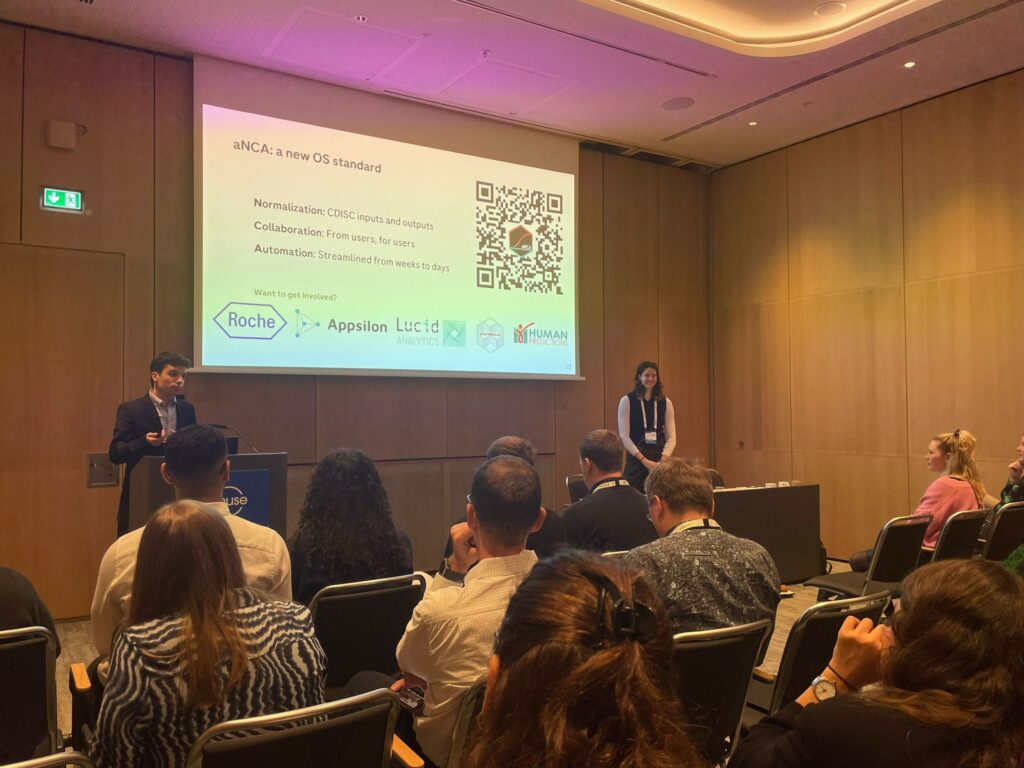
At PHUSE EU Connect 2025, our team presented exactly that solution: aNCA, an automated, user-friendly application designed to streamline PK workflows. Not only did the talk spark interest across the Open Source Technology community, it was awarded Best in Stream !
What is aNCA?
aNCA stands for “Automated Non-Compartmental Analysis”, and is an R package developed by Roche in collaboration with Appsilon and Human Predictions. It is part of the Pharmaverse–a connected network of companies and individuals working to promote collaborative development of curated open source R packages for use in the pharmaceutical industry.
The package contains a number of functions that process and analyse data, but its main feature is a function that uses these internal functions to run the package as a Shiny application. This application enables users to upload their datasets and perform Non-Compartment Analysis (NCA) on both pre-clinical and clinical datasets, with easily visualized results. Designed with user-friendliness in mind, this app aims to make NCA accessible and straightforward for all scientists, even those with no programming knowledge.
Non-Compartmental Analysis matters in pharmacokinetics
NCA is a fundamental pharmacokinetic data analysis used to evaluate the exposure of a drug to understand its lifecycle in the body, which can be used to make dosing decisions. It is a simple and quick method using a concentration-time plot that calculates important parameters such as the maximum observed drug concentration (Cmax), the time to reach maximum concentration (Tmax), the area under the curve (AUC), and the drug’s half-life (the time it takes for its concentration to reduce by half). These parameters are then compared across different patients and doses to understand the variability of the drug, and can be plotted against biomarker data in order to understand the most effective concentrations and exposure ranges.
The aNCA application
The aNCA package was created as an open-source solution for both clinical and pre-clinical pharmacologists. The workflow is smooth, eliminating the need for multiple platforms or expensive proprietary software. By making the package open-source, Roche opened up to the benefits of cross-company collaboration, which has both strengthened the application and also allowed for better sharing of knowledge between developers. aNCA is designed for users with limited programming experience- it is interactive and easy for anyone to use.
Among the features it currently possesses, the app provides an end-to-end workflow including:
- Initial data exploration with a variety of graphs.
- NCA (using the PKNCA package developed by Human Predictions), with customizable options such as analyte, profile, and matrix selection, user-defined parameter selection, and parameter ratios.
- Customizable half life calculation: either by rule settings definitions or performing manual in-plot adjustments.
- Calculation of custom AUC intervals of interest, with last-observed and to-infinity calculations provided by default.
- Visualization of results with interactive boxplots and summary statistic tables.
- CDISC-compliant ADNCA, PP, and ADPP dataset formats of the resulting parameters.
- Customizable TLGs in a ready-to-report format, for sending to the regulatory authorities.
aNCA is adapted to CDISC standards and- while flexible- is optimised for CDISC ADNCA data as an input to the application. The ADPP and PP outputs are also CDISC compliant and validated.
Key insights and takeaways from PHUSE EU Connect
PHUSE EU Connect continues to be one of the most influential gatherings in the statistical programming and data science community. Here are some standout highlights relevant to the industry, and resonating with the spirit of aNCA.
Jeff Abolafia from Certara highlighted the significant challenges that CDISC standards face in accommodating Real-World Data (RWD). These standards often rely on protocol-defined structures and detailed subject-level data, which are difficult to obtain in non-trial settings.
Meanwhile, colleagues from Sycamore Informatics (Sanyogeeta H. Andhale, Bill Qubeck, Nachiket Thakkar) explained how FHIR is emerging as the preferred standard for structuring and exchanging RWD. They emphasized that the FDA’s proposal to incorporate FHIR as a submission format could likely influence global adoption of this approach, reshaping the landscape for regulatory submissions.
At Graticulate Inc., Jennifer Dusendang and Yuval Koren underscored the transformative potential of linking RWD across multiple sources to enrich its research value. They also highlighted the key challenges involved in data linkage and offered guidance on areas that require close attention to avoid complications and prevent false-positive linked patients.
At Roche Mathieu Cayssol and Dr. Christoph Centner guided us through their Code Search Agent. An AI tool leveraging LLM automation to optimize cross-functional collaboration through team code sharing on big repositories. By searching code and scaling statistical programming capacities.
Also at Roche, Vincent Buchheit talked to us on despite how theoretically easy PK data is, the reality behind its management can sometimes become really really complicated. Missing data, lab problems or data collection issues can lead to some of the biggest nightmares for a statistical programmer. Luckily their expertise can keep benefitting everyone
Why aNCA matters for the future of PK analysis
While conceptually simple, NCA can become surprisingly complex, especially when dealing with messy real-world PK data, missing values, assay differences, or collection inconsistencies. As noted in complementary talks at PHUSE (e.g., Vincent Buchheit from Roche), the “easy” PK tasks sometimes become the most challenging ones.
This is where aNCA shines.
As the industry shifts toward:
- open-source adoption,
- transparent analytics,
- CDISC alignment,
- streamlined regulatory workflows, and
- democratised scientific tooling,
tools like aNCA are essential.
By providing a validated, intuitive interface built on robust R packages, aNCA empowers organisations to perform NCA faster, more consistently, and more collaboratively, without sacrificing scientific rigour.
Get involved
The aNCA package represents a significant step forward in making NCA more accessible, collaborative, and efficient.
To explore the aNCA application or contribute to its development:
aNCA is more than a tool, it’s a step forward in making pharmacokinetics accessible to everyone.